

FSSC 22000 Lead Auditor Training: Building Expertise in Food Safety Auditing
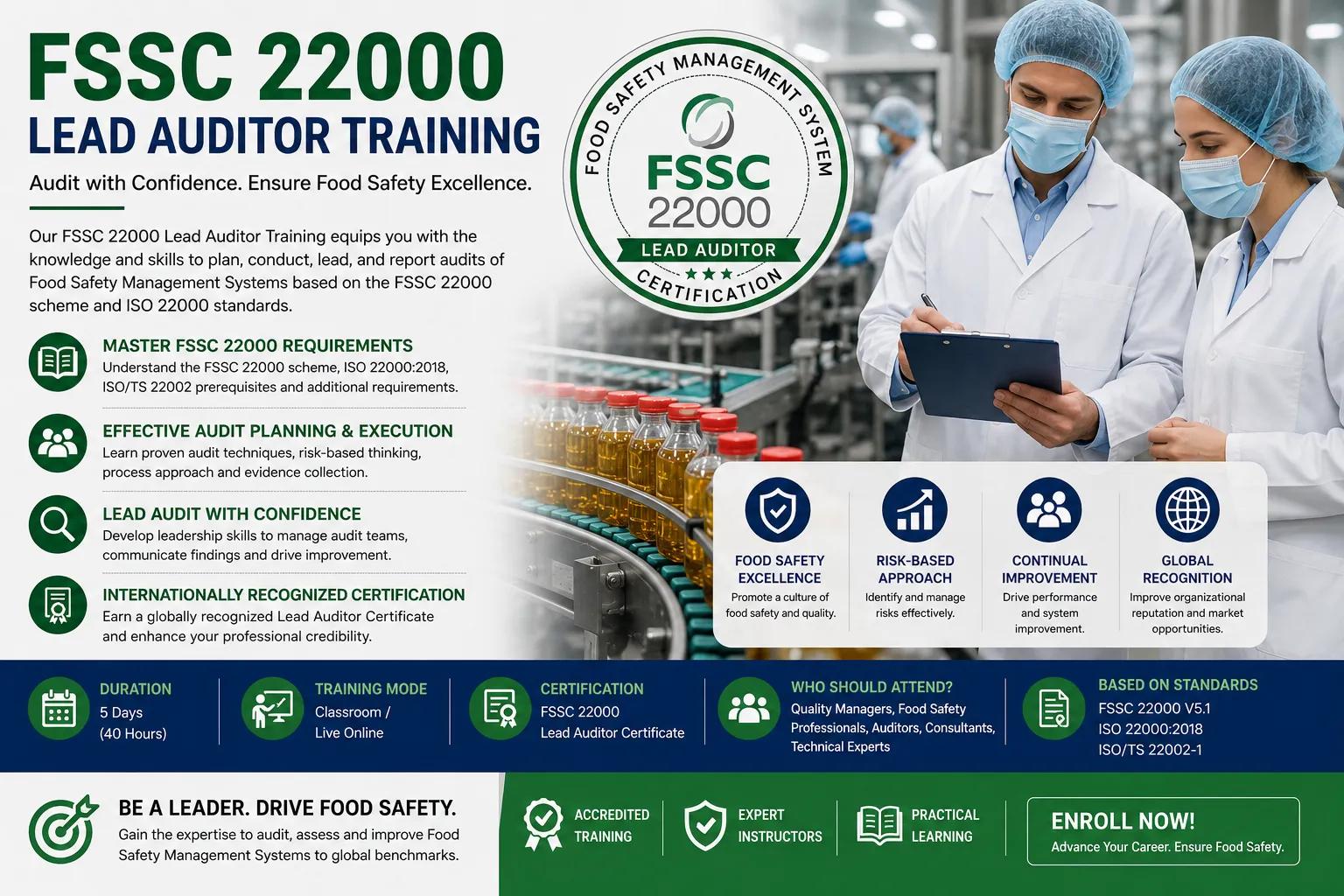
FSSC 22000 Lead Auditor Training:
Introduction
Food safety organizations need more than documented procedures to maintain effective control over food safety risks. They also need qualified professionals who can examine those procedures, verify their implementation, identify weaknesses, and recommend appropriate improvements. This makes competent auditing an important part of a successful food safety management system.
FSSC 22000 Lead Auditor Training helps professionals develop the knowledge and practical capabilities required to conduct systematic food safety management system audits. The course introduces participants to audit planning, evidence gathering, interviewing, evaluation of findings, reporting, and follow-up. It can be particularly valuable for professionals working in food manufacturing, quality assurance, food safety, consulting, and management systems.
What Is FSSC 22000 Lead Auditor Training?
FSSC 22000 is a food safety certification scheme that provides a structured framework for organizations throughout relevant parts of the food supply chain. It incorporates ISO 22000 requirements along with applicable prerequisite programs and additional scheme requirements.
Lead Auditor Training concentrates on how to assess such a system effectively. Rather than simply reviewing documents, auditors need to determine whether processes actually operate as planned and whether the organization controls food safety risks effectively.
During the training, participants learn how to prepare an audit, establish audit objectives and scope, review relevant information, communicate with audit teams and employees, collect objective evidence, and assess whether requirements have been fulfilled.
The course also helps participants understand the responsibilities of a lead auditor. Leading an audit requires organization, professional judgment, communication skills, and the ability to keep the audit focused on defined criteria.
Major Topics Covered in the Course
A well-structured FSSC 22000 Lead Auditor Training program generally combines theoretical learning with practical auditing exercises. Participants become familiar with the principles and methods used to conduct management system audits.
Audit planning is an important part of the program. Participants learn how to determine audit objectives, define the scope, identify audit criteria, allocate responsibilities, and prepare an appropriate audit schedule.
Audit execution is another major area. Participants learn how to conduct opening meetings, interview personnel, observe activities, examine records, and collect reliable evidence. They also learn how to follow audit trails so that they can evaluate whether processes meet specified requirements.
Training may cover areas such as:
Principles and fundamentals of auditing
FSSC 22000 requirements and structure
Audit objectives, scope, and criteria
Audit program and audit planning
Audit team responsibilities
Opening and closing meetings
Interview and questioning techniques
Objective evidence collection
Audit trail development
Identification of nonconformities
Classification and documentation of findings
Corrective action evaluation
Audit reporting
Follow-up audits
Auditor competence and professional conduct
Practical activities can help participants understand how these concepts apply in real workplace situations.
Who Can Benefit from This Training?
FSSC 22000 Lead Auditor Training is relevant to professionals who are responsible for food safety, quality, compliance, or auditing activities.
Food Safety Managers: They can use auditing knowledge to evaluate whether food safety procedures are effectively implemented throughout an organization.
Quality Assurance Professionals: QA teams can strengthen their ability to assess processes, identify gaps, and verify corrective actions.
Internal Auditors: Professionals already involved in internal auditing can improve their audit planning, interviewing, evidence-gathering, and reporting techniques.
Food Safety Consultants: Consultants can use lead auditor skills when conducting assessments, supporting implementation projects, and helping organizations improve their management systems.
Supplier Auditors: Professionals responsible for evaluating suppliers can apply systematic auditing techniques when assessing food safety controls and related processes.
Food Industry Managers: Production, operations, warehouse, procurement, and quality managers can gain a clearer understanding of how food safety systems are evaluated.
The training may also appeal to professionals planning to build a career in food safety auditing or management system auditing.
Benefits of FSSC 22000 Lead Auditor Training
The training can provide both professional and organizational advantages. One of its main benefits is helping participants understand how to conduct audits using a structured and evidence-based approach.
Key benefits include:
Improved understanding of FSSC 22000 auditing principles
Better preparation and planning of audits
Stronger interviewing and communication abilities
Improved evidence-gathering techniques
Greater confidence in identifying nonconformities
Better understanding of corrective action evaluation
Improved audit documentation and reporting
Stronger ability to manage audit activities
Enhanced professional credibility
Support for career development in food safety
Better contribution to continual improvement activities
For organizations, trained auditors can provide a valuable internal resource. Effective audits can reveal weaknesses before they become significant food safety problems and can help management understand where additional controls or improvements may be required.
Developing the Skills of an Effective Lead Auditor
A successful lead auditor needs more than knowledge of standards. Auditing involves working with people, analyzing information, managing time, and making objective decisions.
Communication is particularly important. Auditors need to ask clear questions and listen carefully to responses without creating unnecessary tension. They must also explain findings in a professional manner so that employees and management understand what the evidence indicates.
Analytical thinking is equally important. Auditors may need to compare procedures with actual practices, follow information through different departments, examine records, and determine whether evidence supports a finding.
Objectivity is another essential quality. An auditor should base conclusions on verifiable evidence rather than personal assumptions. Maintaining independence and professional judgment helps ensure that audit results remain credible.
Training exercises, case studies, role-playing, and simulated audits can help participants develop these practical abilities in addition to learning the theoretical requirements.
Career Development Opportunities
Professionals who complete FSSC 22000 Lead Auditor Training can strengthen their qualifications for various roles within the food safety and quality sector. Potential career paths can include internal auditing, food safety auditing, quality assurance, supplier auditing, food safety consulting, and management system coordination.
The training can complement qualifications or experience in areas such as food technology, microbiology, HACCP, ISO 22000, quality management, food production, or food safety management.
It is important to understand that completing a lead auditor course alone does not automatically provide certification as an accredited third-party certification auditor. Specific auditor credentials may require additional education, professional experience, examinations, audit experience, or other requirements established by the relevant certification or personnel qualification scheme.
Conclusion
FSSC 22000 Lead Auditor Training offers professionals an opportunity to develop structured and practical auditing skills for food safety management systems. From audit planning and evidence collection to identifying findings and evaluating corrective actions, the training covers essential activities involved in effective auditing.
For food safety managers, quality professionals, internal auditors, consultants, and other food industry personnel, these skills can contribute to stronger professional performance and better organizational oversight. By combining technical understanding with communication, analytical thinking, and objective decision-making, trained auditors can play an important role in maintaining food safety and supporting continual improvement.